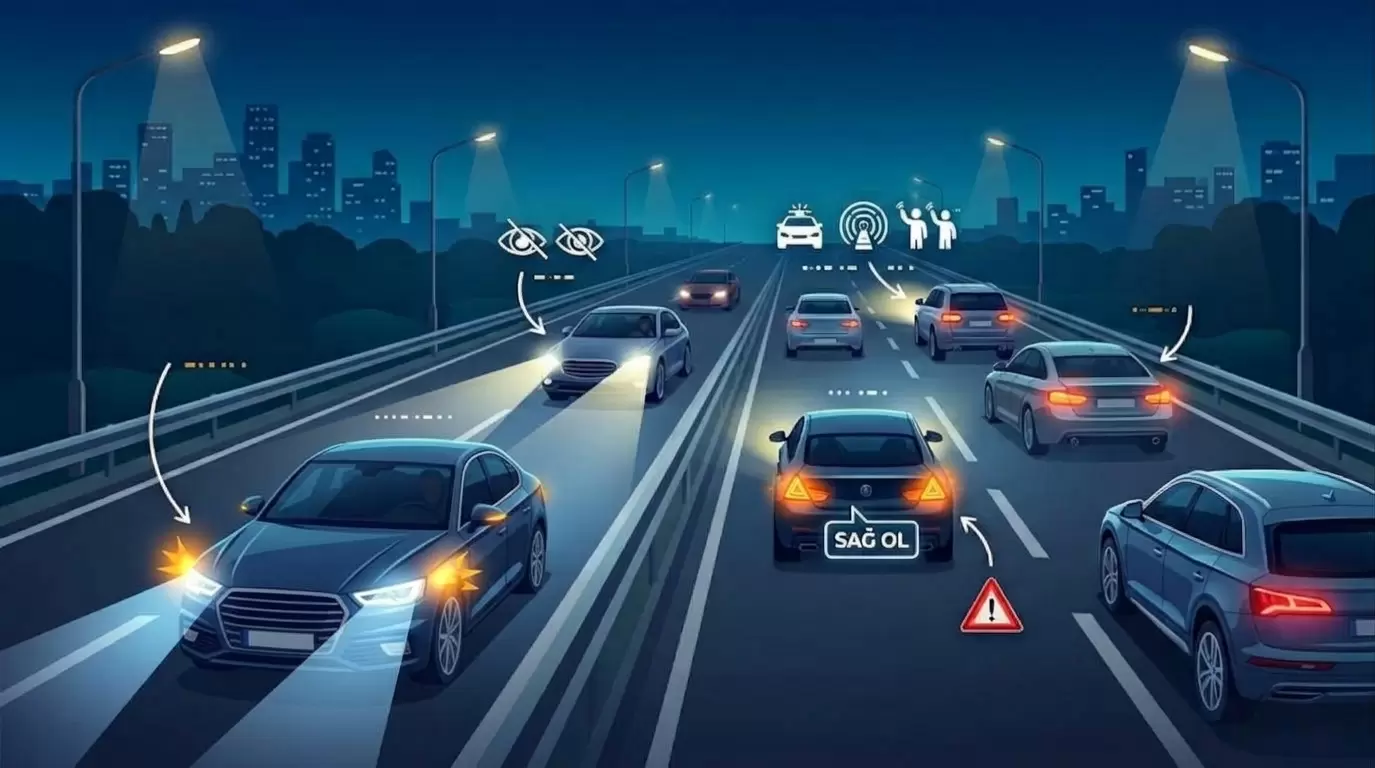
Every driver has their own language on the road. Some honk their horns, some stick their hands out of the window, while others switch their headlights on and off as if sending a message in Morse code. The problem is that sometimes neither the person sending the message nor the person receiving it fully understands what it means!
What is even more interesting is that many drivers use their vehicle's light signals but either do not know the correct rules for using them or fail to follow them despite knowing them.
Let's see what messages we send to other drivers by flashing our headlights on the road.
1. Flashing headlights: A warning or a greeting?
A car approaching from the opposite direction flashes its headlights twice. You immediately start thinking:
"Is there a speed camera or police ahead?"
"Has there been an accident on the road?"
"Do they know me?"
It is not right to interpret every light signal in the same way.
What is even more interesting is that some drivers flash their headlights so much that it feels as if they are running a disco rather than driving a car.
A light signal may serve as a warning to draw attention, but it does not replace traffic rules.
2. High beams: Are we lighting up the road or blinding the oncoming driver...?
You are driving at night. A car approaches from the opposite direction, and its driver seems either unwilling or unable to switch off the high beams.
So, what is the problem? Some drivers do not know when they should switch from high beams to low beams, while others know but are in no hurry to do so.
They seem to think that the more they illuminate the road, the more experienced they will appear as drivers. However, dazzling an oncoming driver is neither professionalism nor road courtesy.
3. Headlight signals from the car behind: What is the emergency?
The car ahead is travelling at a normal speed. Suddenly, the car behind starts flashing its headlights. It feels as if an urgent message is coming from behind!
Some drivers use this method to attract the attention of the vehicle ahead or ask it to clear the way. Others behave as if the road belongs exclusively to them and everyone ahead must immediately move aside.
Of course, light signals can be used to warn about a hazard ahead (for example, a sharp bend or an obstacle) or to request the right of way. However, they must not be used to pressure another driver or force them into a dangerous manoeuvre. If you are dissatisfied with the speed or movement of the vehicle ahead, that does not justify aggressive behaviour.
Unfortunately, some drivers prefer to travel in the left lane even when the right lane is clear. It is as if they do not see or consider the drivers approaching from behind.
4. Hazard lights: A thank-you button or a warning signal?
Some drivers express their gratitude by turning on their hazard lights for a few seconds when another driver gives way to them. This is a good habit commonly seen among drivers.
But let's be honest: sometimes it is difficult to understand why the hazard lights are on. Is the car stopped, moving, changing lanes, or is the driver simply thanking someone?
One of the most common problems on city roads today is drivers stopping their cars in the second lane, turning on their hazard lights, and leaving the area. They behave as if this were completely normal. In reality, such actions obstruct other drivers and go against road courtesy.
The primary purpose of hazard lights is to provide a warning. It is important to know the rules governing their use. These lights inform other road users that a vehicle is creating a hazard or is in a particular situation.
5. Giving way with a light signal: What happened to the rules?
Sometimes a driver flashes their headlights, and the other person interprets it as "go ahead, you can pass." Another driver may interpret the same signal as "stop, do not proceed." As a result, the two drivers look at each other, and neither moves. This is one of the most amusing misunderstandings that occur on the road.
A light signal does not automatically grant priority. Road signs, road markings, traffic rules, and the actual situation must be taken into account when deciding whether to proceed.
In other words, a driver flashing their headlights does not automatically give you the green light. Always exercise caution.
6. The biggest problem: We use light signals, but do we know the rules?
The issue is not just the improper use of headlights. A bigger problem is that many drivers either do not know the rules for using their vehicle's lighting system well enough or fail to follow them despite knowing them.
Sometimes drivers change lanes without using their turn signals. Sometimes high beams dazzle the driver ahead, and sometimes light signals are used to express frustration instead of providing a warning.
The turn signal seems to be the car's greatest mystery. The driver turns, while the person behind has to guess what is happening simply by observing the vehicle's movement.
Then misunderstandings, frustration, and unnecessary arguments begin on the road.
The main point of road traffic is not just driving a car, but also making it possible for other drivers to travel safely.
Let your headlights speak on the road, but make sure they speak the right language!
Light signals are not merely a technical feature of a vehicle; they are an important tool for road safety. Using them correctly affects the safety of both you and other drivers.
Keep the following in mind when driving:
-
Do not use high beams in a way that dazzles oncoming drivers.
-
Activate your turn signals in good time before manoeuvring.
-
Do not use headlights as a means of aggression, pressure, or argument.
-
Do not automatically assume that another driver's light signal conveys the correct message; assess the situation and follow traffic rules.
-
Use hazard lights for their intended purpose.
Final thoughts: Sometimes, a single light signal on the road can replace a thousand words. But for that to happen, its meaning must be understood and it must be used correctly.
Dear drivers, just because your car's headlights work does not mean you know how to communicate properly with them. Let's reduce the light shows on our roads and increase road courtesy instead.
MegaCar.az — Understanding behind the wheel, mutual respect on the road!