Drivers who travel on the streets of Baku every day encounter potholes, damaged asphalt, road depressions and uneven surfaces. Sometimes, after driving over such obstacles, the driver does not notice any problem with the vehicle and continues driving. However, a strong impact can affect several important components of the vehicle at the same time.
In particular, hitting a pothole at high speed can cause damage to various components, from the tires to the suspension and steering systems.
What happens to your car when you hit a pothole?
The depth of the pothole, the vehicle's speed and the force of the impact all affect how serious the resulting problem can be. Even an impact that seems minor can show different symptoms after some time.
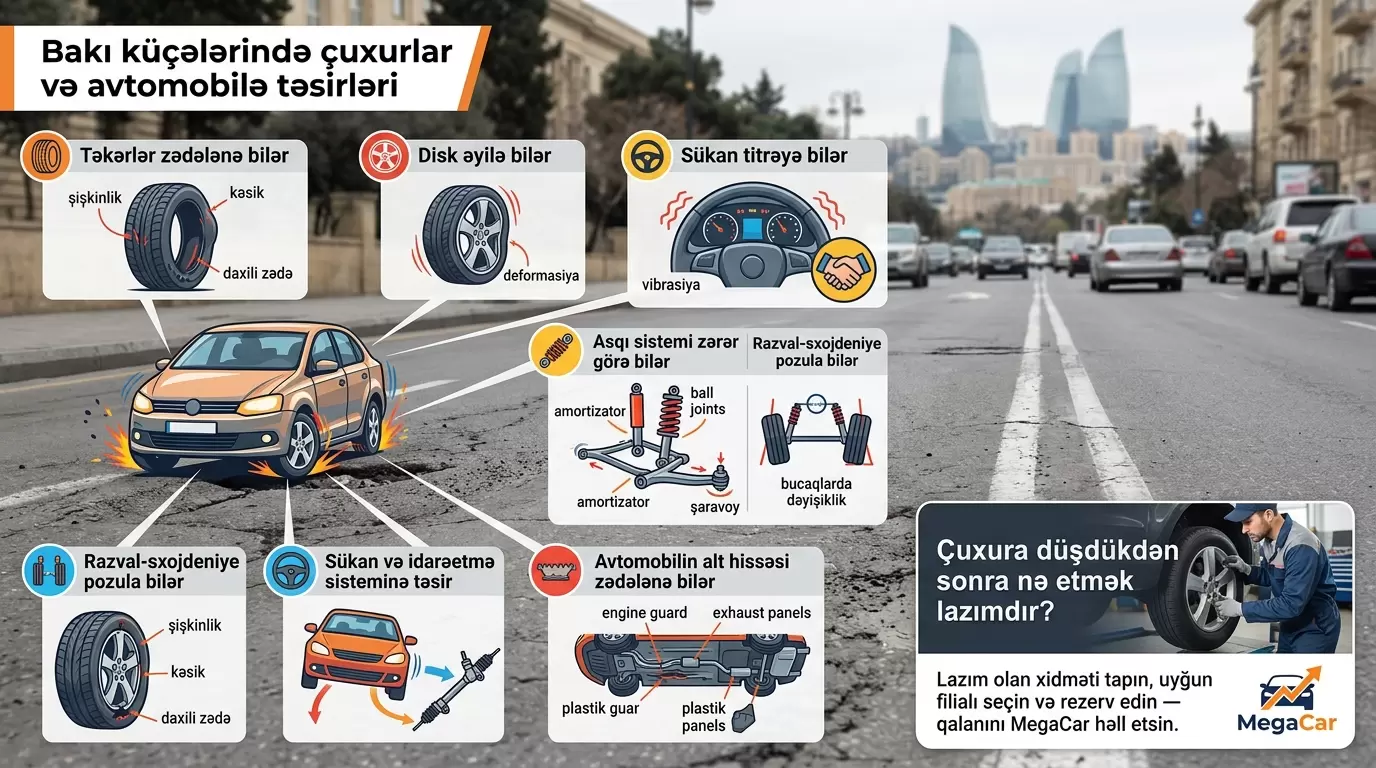
Tires can be damaged
A strong impact with a pothole can cause bulges, cuts or damage to the internal structure of the tire's sidewall. Some types of damage may not be immediately visible.
If you notice a bulge or serious deformation on the tire, driving at high speed can be dangerous. It is safer to have the condition of the tire checked by a specialist.
The wheel rim can become bent
One of the common problems after hitting a pothole is a bent or damaged wheel rim. This can affect the proper seating and movement of the tire.
The driver may later notice vibration at high speeds or feel that the vehicle behaves differently than before.
The steering wheel may vibrate
Steering wheel vibration after a strong impact on the road should not be ignored. The cause may be wheel imbalance, a damaged rim or a problem with suspension components.
If the vibration started after the impact, it is advisable to have the vehicle inspected.
The suspension can be damaged
The suspension system helps the vehicle handle uneven road surfaces more comfortably. However, deep potholes and strong impacts can place additional loads on shock absorbers, control arms, ball joints, rubber-metal components and other parts.
When the suspension is damaged, you may notice knocking sounds, unusual noises, excessive body movement or changes in handling while driving.
Wheel alignment can be affected
A strong impact can change the wheel alignment angles. This is commonly known as a wheel alignment problem.
As a result, the vehicle may pull to one side on a straight road, the steering wheel may no longer remain centered, and the tires may wear unevenly.
The steering and handling system can be affected
If the vehicle feels different to drive after hitting a pothole, this should not be considered normal. Components of the steering system and front suspension may have been affected by the impact.
If the vehicle pulls to one side, the steering wheel vibrates or its behavior has changed, this is a reason to have the vehicle inspected.
The underside of the vehicle can be damaged
Deep potholes and sharp road-surface irregularities can also pose a risk to components located underneath the vehicle.
The engine undertray, certain plastic and metal components, the exhaust system and other parts located underneath the vehicle can be damaged by a strong impact.
What should you do after hitting a pothole?
If you hit a pothole with a strong impact, it is advisable to stop in a safe place and inspect the vehicle.
Visually check the tires and wheel rims. Look for any bulges, cuts or deformation on the tires. Then, while driving, pay attention to the steering wheel, vibrations, unusual noises and whether the vehicle pulls to one side.
If you notice any changes after the impact, it is advisable to check the tires, wheel balancing, wheel alignment and suspension before the problem becomes more serious.
Even if we cannot change the roads, we can protect our cars
Damaged roads and potholes are problems that drivers cannot always avoid. However, adjusting your speed to road conditions, maintaining a safe distance and approaching potholes carefully can help reduce the impact on your vehicle.
Most importantly, do not ignore small changes that appear after an impact. Steering wheel vibration, the vehicle pulling to one side, a bulge on the tire, or a new noise or vibration may be the first signs of a more serious problem.
If you notice a change in your vehicle's behavior after hitting a pothole, do not put the problem off. Find the service you need, choose a suitable branch and make a reservation — MegaCar will take care of the rest.